


Page 8 - Logistics News May 2016
P. 8
rental deliveries

Netflix: Managing Jurassic Park

I’m sure most Logistic News readers are familiar with Netflix, the video-on-demand streaming
                     service that offers many of the world’s most enticing TV series.

                              By Rick de Klerk

What you may not know, however, is Netflix’s origins as       centre, and to accurately stock what customers were
an online DVD mail-order rental competing with the now        requesting.
vanquished Blockbuster video rental retail chain in the
United States. This arm of Netflix continues to this day;         Netflix implemented a queuing wish list system that
a modern-day Jurassic Park, a profitable wonderland of        encouraged users to queue up their preferred titles ahead
fossils in the face of Netflix’s own ascendant streaming      of time and actively rate the titles that were recommended
service.                                                      to them. According to an unpublished paper by Lauren
                                                              Fraser et al, ‘Netflix: Disrupting Blockbuster’, Netflix
    Launched a year prior to Google in 1997, how did          actively sought customer input to shape its predictive
Netflix – which Blockbuster declined to purchase for the      models by tying them to the service.
meagre price of US$50 million – come to dominate the
physical rental market?                                           Combined with the removal of late-return fees, it
                                                              had the beneficial effect of weaning watchers off the
    While there’s a confluence of factors that came           ‘impulse’ rental model, acclimatising users to delayed
together, I’d like to focus on the company’s distribution     deliveries by balancing the wait against the convenience
model and its early adoption of predictive algorithms         of being able to watch the movies at their own leisure.
to mitigate some of the challenges of centralised
distribution. Netflix saw an opportunity in the new DVD           Today, Netflix operate some 33 distribution centres
format to implement a cost-effective mail-order system        across the US (according to a Times article on the
for films, cutting out the need for physical branches         topic), with extensive use of automation used to create
while minimising the cost of stockholding.                    better efficiencies. It continues to prop up many of
                                                              Netflix’s new initiatives, which have sometimes failed in
    One of the first takeaways is that even as a company      spectacular fashion.
that very much had the pulse of
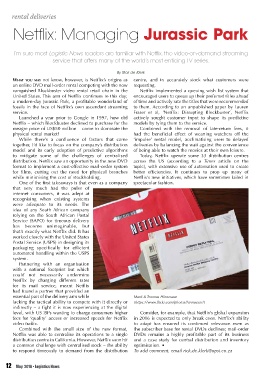
internet consumers, it was adept at                           Marit & Toomas Hinnosaar
recognising when existing systems                             (https://www.flickr.com/photos/hinnosaar/)
were adequate to its needs. The
idea of any South African company                                 Consider, for example, that Netflix’s global expansion
relying on the South African Postal                           in 2016 is expected to only break even. Netflix’s ability
Service (SAPO) for timeous delivery                           to adapt has ensured its continued relevance even as
has become unimaginable, but                                  the subscriber base for rental DVDs declines; mail-order
that’s exactly what Netflix did. It has                       DVDs remains a highly profitable part of its business
worked closely with the United States                         and a case study for central distribution and inventory
Postal Service (USPS) in designing its                        optimisation. •
packaging specifically for efficient                          To add comment, email rick.de.klerk@opsi.co.za
automated handling within the USPS
system.

    Partnering with an organisation
with a national footprint but which
could not necessarily undermine
Netflix by charging different rates
for its mail service, meant Netflix
had found a partner that provided an
essential part of the delivery arm while
lacking the tactical ability to compete with it directly or
indirectly – a fight it is now experiencing at the digital
level, with US ISPs wanting to charge consumers higher
fees for ‘quality’ access or increased speeds for Netflix
video traffic.

    Combined with the small size of the new format,
Netflix was able to centralise its operations to a single
distribution centre in California. However, Netflix soon hit
a common challenge with centralised stock – the ability
to respond timeously to demand from the distribution

12 May 2016 • Logistics News

