


Page 12 - Logistics News June 2019
P. 12
Thought Leadership


                             New RFID staple


                        tag for rough wood


                                                                             By Claire Swedberg, courtesy RFID Journal


              Utility Composites has created a tag that can be stapled directly into a tree, plank,
               pallet, railroad tie or other wooden item, with a read range of 35 feet, and which
                                              can be read through water.


            WHILE THE forestry service provides a use
            case for ultra-high frequency radio-frequency
            identifi cation (UHF RFID) technology – tracking
            each felled tree or each cut plank from forest
            to retail – there hasn’t been an RFID tag that
            is uniquely suited for this environment. Rough
            wood doesn’t lend itself well to adhesives, so UHF
            RFID labels could be knocked or blown off . Tags
            screwed into the wood can create problems for
            mills that use cutting equipment incompatible
            with metal. They also require several minutes for
            installation.
               Utility Composites, a Texas-based fastener
            company, has built its solution to this problem with
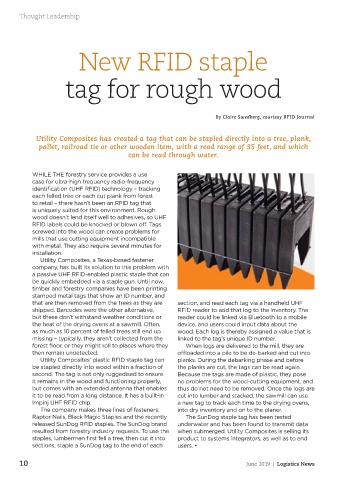
            a passive UHF RFID-enabled plastic staple that can
            be quickly embedded via a staple gun. Until now,
            timber and forestry companies have been printing
            stamped metal tags that show an ID number, and
            that are then removed from the trees as they are   section, and read each tag via a handheld UHF
            shipped. Barcodes were the other alternative,      RFID reader to add that log to the inventory. The
            but these don’t withstand weather conditions or    reader could be linked via Bluetooth to a mobile
            the heat of the drying ovens at a sawmill. Often,   device, and users could input data about the
            as much as 10 percent of felled trees still end up   wood. Each log is thereby assigned a value that is
            missing – typically, they aren’t collected from the   linked to the tag’s unique ID number.
            forest fl oor, or they might roll to places where they   When logs are delivered to the mill, they are
            then remain undetected.                            offl  oaded into a pile to be de-barked and cut into
               Utility Composites’ plastic RFID staple tag can   planks. During the debarking phase and before
            be stapled directly into wood within a fraction of   the planks are cut, the tags can be read again.
            second. The tag is not only ruggedised to ensure   Because the tags are made of plastic, they pose
            it remains in the wood and functioning properly,   no problems for the wood-cutting equipment, and
            but comes with an extended antenna that enables    thus do not need to be removed. Once the logs are
            it to be read from a long distance. It has a built-in   cut into lumber and stacked, the sawmill can use
            Impinj UHF RFID chip.                              a new tag to track each time to the drying ovens,
               The company makes three lines of fasteners:     into dry inventory and on to the planer.
            Raptor Nails, Black Magic Staples and the recently    The SunDog staple tag has been tested
            released SunDog RFID staples. The SunDog brand     underwater and has been found to transmit data
            resulted from forestry industry requests. To use the   when submerged. Utility Composites is selling its
            staples, lumbermen fi rst fell a tree, then cut it into   product to systems integrators, as well as to end
            sections, staple a SunDog tag to the end of each   users. •


        10                                                                              June 2019  |  Logistics News

