

Fuel is the largest controllable cost in most fleets, yet it’s still managed after the fact. Spend is reviewed at month-end, the same questions repeat, and the same waste returns. When fuel is sitting at 30-40% of total operating cost, and a meaningful portion is preventable through better driving behaviour, that’s not a small gap.

- ADVERTORIAL -
The problem is not that fleets lack data. It’s that fuel data, trip data, and driver behaviour rarely come together in a way that supports action. A transaction tells you what was purchased, not why it was consumed. Telematics tells you what happened on the road, not whether the fuel use was reasonable for that trip. Without context, teams rely on averages and assumptions, and fuel stays a finance discussion instead of an operational discipline.
That’s the gap Ctrack’s Fuel Management plug-in is built to close. It’s designed to turn fuel from hindsight reporting into fuel performance management, so waste is identified early, explained clearly, and corrected consistently.
Why fuel stays expensive, even in well-run fleets
Most fuel programmes fall into the same three traps.
First, fuel data is fragmented. Transactions arrive from multiple suppliers, cards, and exports. When data is scattered, validating it becomes a job on its own, and the opportunity to manage fuel is lost in admin.
Second, there’s no context. A fleet can see total litres and total spend, but not whether that consumption was expected for the route, vehicle, and conditions. That’s when the conversation becomes reactive.
Third, intervention happens late. Even if managers identify poor driving habits or unusual trends, the cost has already repeated for weeks. Coaching becomes inconsistent, and improvement is hard to measure.
This is why fuel control often feels like a finance debate rather than an operational discipline.
The shift: from fuel reporting to fuel performance
Fuel Management is built around a simple idea: fuel control improves when you can connect three things in one place, what was bought, how it was used, and what should have happened.
It starts by consolidating fuel transactions into a single view. When the foundation is clean and complete, the rest becomes possible. The platform then enriches fuel with operational context, linking fuel to distance and allocation, so fuel is not viewed as a standalone number.
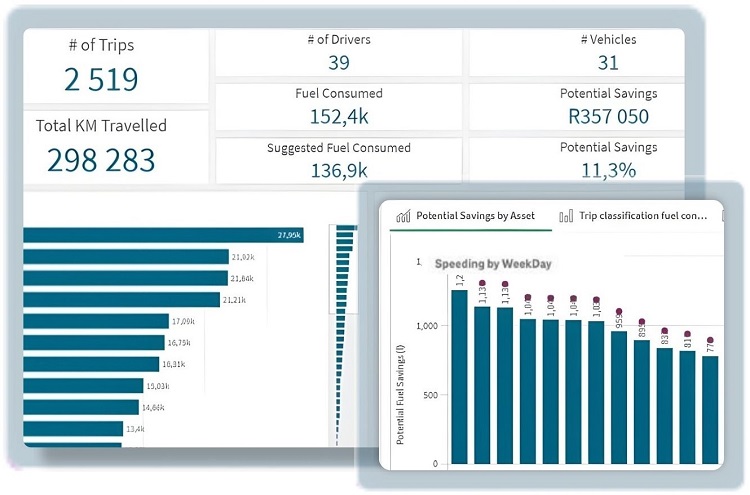
The key step is prediction. Instead of relying on averages, Fuel Management benchmarks expected fuel per vehicle and route and compares it to actual consumption. The gap between expected and actual highlights opportunity early, while it’s still fixable. This is where fuel management becomes practical, teams stop asking “why was fuel high?” and start asking “what is driving the difference, and what do we do next?”
Insight without action is just another report
The best dashboards in the world won’t change fuel cost if nothing changes on the road.
That’s why Fuel Management is designed around action, not just visibility. When a driver’s performance falls below the expected benchmark or triggers a focus point, a structured debrief can be created and closed out through a consistent workflow. It replaces ad hoc “driver chats” with a repeatable process that is fair, documented, and measurable.
Alongside this, in-cab coaching supports immediate self-correction. When drivers get real-time prompts for behaviours linked to fuel waste, improvements happen in the moment, not weeks later in a debrief meeting. Fleets using this kind of approach often see meaningful fuel improvements because the feedback loop is shorter and behaviour change is more likely to stick.
Where savings really come from
Most fleets already suspect where fuel waste comes from. The difficulty is proving it clearly enough to manage it consistently.
Fuel Management makes it easier to identify which behaviours are driving overconsumption, for example excessive idling, poor speed consistency, harsh acceleration, and inefficient RPM habits. This matters because “fuel is high” is not a management instruction. “This pattern is costing you money, and this is what to change” is.
The outcome is practical prioritisation. Teams stop spreading effort across everything and focus on the few drivers, routes, and behaviours that are driving the majority of the loss.
A glimpse of the benefits fleets are seeing
The value of fuel performance management should show up in outcomes, not just in better charts.
Fleets using integrated fuel control approaches like this have seen results such as measurable reductions in total fuel spend, improved driver consistency through clearer coaching, and less manual admin because the process is structured and repeatable. Where fuel improvement is paired with better driving habits, many fleets also report fewer avoidable incidents, because safer, more consistent driving tends to improve both fuel efficiency and risk exposure.
The deeper benefit is that fuel stops behaving like a surprise. It becomes something managers can control during the month, with clearer priorities, faster correction, and measurable improvement over time.
Fuel will always be a big number in fleet operations. The question is whether it stays a headache, or becomes a lever.
For more information, please visit www.Ctrack.com