
As regional trade intensifies and supply chains come under increasing pressure, Stanbic Bank says the next phase of Africa’s corridor development will be defined not by infrastructure investment alone, but by how efficiently those systems convert movement into economic value.
Reflecting on the recent Land‑Linked Zambia 2026, under the theme, “Beyond Borders: Shaping the Future of Africa’s Transport Corridors for Shared Prosperity’, Stanbic noted a decisive shift in the corridor conversation, from long‑term infrastructure ambition to the immediate economics of execution.
“What has changed is not the recognition of corridors as critical assets, but the urgency around how they perform,” said Head Business & Commercial Bank, Chanda Mwila. “The question is no longer what needs to be built, but how effectively existing systems translate activity into growth.”
As Zambia consolidates its position as a land‑linked trade hub, rising mining output, increased fuel flows and expanding regional trade are driving sustained volumes through key routes. According to Mwila, this is exposing a more complex reality: inefficiency within corridors is no longer a logistical inconvenience, but a direct economic constraint.
“Every delay, every point of friction, has a cost,” Mwila said. “It affects how quickly capital turns, how reliably businesses can operate, and ultimately how competitive entire value chains become.”
Corridor performance is increasingly shaping investment decisions, with predictability and reliability emerging as critical factors alongside physical capacity.
“Investors are not only assessing infrastructure availability, but they are also assessing system performance,” Mwila noted. “The ability to move goods consistently, manage timelines and reduce uncertainty is now central to how markets are evaluated.”
From a financial sector perspective, enabling trade at scale requires closer alignment between logistics systems and financial flows. While infrastructure enables movement, it is the efficiency of transactions that determines whether value is realised.
Trade does not stall only at borders; it stalls in systems. Payment delays, constrained access to working capital and currency complexity all slow the movement of goods as much as physical bottlenecks do. As trade volumes increase, these inefficiencies compound, tying up liquidity and limiting the ability of businesses to respond to demand across markets.
“The velocity of trade is directly linked to the velocity of capital. Improving corridor performance is therefore as much a financial priority as it is an operational one,” concluded Mwila.
Stanbic reaffirmed its commitment to supporting Zambia’s trade and logistics ecosystem through solutions designed to improve capital flow, enhance transaction efficiency and enable more predictable cross‑border operations.
The Conference highlighted a powerful, co-ordinated push to transform Zambia from a landlocked nation into a strategic land-linked hub for the African continent.
Minister of Transport and Logistics, Honourable Frank Tayali delivered the keynote address, emphasizing the urgent need for Africa to prioritize internal trade. “Africa must trade more with itself before it trades with the rest of the world,” stated Hon. Tayali. “We cannot continue to export raw materials across oceans while importing finished goods at higher cost.”
The Minister outlined significant infrastructure advancements aimed at restoring Zambia’s strategic advantage, including the revitalisation of TAZARA, the recapitalisation of Zambia Railways, and the ambitious Kafue-Lion’s Den Railway Project with Zimbabwe. Furthermore, the implementation of One-Stop Border Posts at Kazungula, Chirundu, Nakonde, and Mwami is actively reducing delays and improving trade efficiency.
However, Hon. Tayali stressed that infrastructure alone is insufficient. The future lies in evolving these routes into comprehensive economic corridors by establishing logistics hubs, dry ports, agro-processing zones, and industrial parks to ensure local communities benefit directly from trade.
Stanbic Bank reaffirmed its commitment to enabling regional commerce by providing essential working capital to keep fleets and supply chains moving, and by facilitating the cross-border payments that underpin the African Continental Free Trade Area (AfCFTA). Ms Mwila added, “Prosperity beyond borders will not be achieved by infrastructure alone, or by any single institution. It will be achieved through co-ordinated action, informed decision-making, and a shared commitment to execution.”
The Land-Linked Zambia 2026 Conference concluded with a unified call to action for deeper regional partnerships, harmonized regulations, and joint investments. By choosing collaboration over competition, Zambia and its regional partners are laying the groundwork to reduce the cost of doing business and redefine Africa’s place in the global economy.
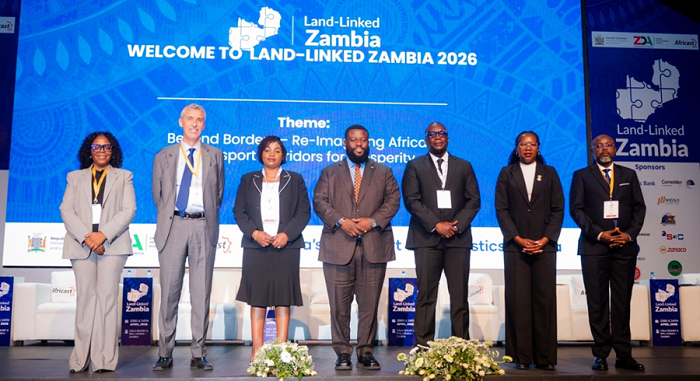
In pic from left to right: Stanbic bank Head of Business & Commercial Bank- Chanda Mwila, EU Delegation Head of Cooperation Claudio Bacigalupi, Acting PS Ministry of Transport Dr Cynthia Balengu, Minister of Transport, Communication & Logistics Frank Tayali, AFRICAST MD Chimwemwe Nyirenda, ZDA deputy director investment promotions Petronella Ndimbwa & Central Corridor Transit Transport Agency Executive secretary Adv. Flory Okenge.