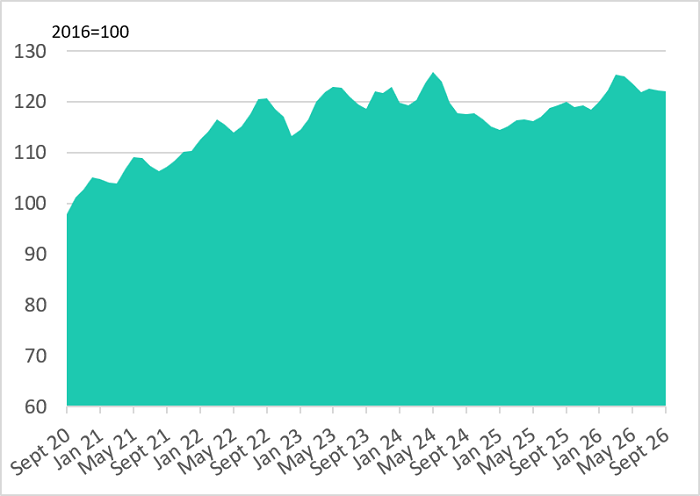
After a strong broad-based recovery in Q1 2026, the Ctrack Transport and Freight Index (Ctrack TFI) declined notably in Q2, but recouped some losses in Q3 – see graph 1. At a level of 122.2 the index is up by a marginal 0.2% compared to Q2, and still up by 1.8% compared to a year ago. The economic scenario in South Africa has taken a turn for the worse following the outbreak of the Middle East conflict.
Significant fuel price increases since April had a notable negative impact across the economy, from households to the energy intensive sectors such as mining and manufacturing to each business transporting goods across the country. Higher transport costs translated into higher inflation, triggered two interest rate increases and depress confidence levels. The different transport modalities reacted differently to the economic challenges, with ongoing structural reforms for example providing a cushion for the rail freight sector. However, with economic activity in general been muted amid the uncertainty created by the ongoing conflict, demand for transport services remained strained in Q3.
GRAPH1: CTRACK TRANSPORT & FREIGHT INDEX (2016=100)
Given the broad-based weakness recorded in Q2 (coinciding with a quarterly contraction in GDP), all but one of the transport modalities recorded some improvement on a quarterly basis, with only the heavy weighted road freight sector contracting further in Q3. With no end in sight for the Middle East conflict (Brent crude oil price at time of writing was around $114/bbl), and thus no end in sight for the elevated fuel prices in the economy, government has announced some relief for November and December, by forfeiting a part of the fuel levies included in fuel prices. This is the second time that government decided to intervene to support the economy, this time the relief will be capped at R10bn vs previous support that totalled about R17.2bn. While welcomed, the cumulative impact of the conflict on local (and global) fuel prices remains significant. Even after incorporating the announced relief, the 95-ULP Petrol and 0.05S Diesel prices would still have increased, cumulatively between March and November, by approximately R10/litre and R12/litre, respectively. It will be rather impossible for companies to fully absorb the extent of these increases and the risk for widespread upward adjustments to prices across the economy remains very high, especially given the country’s dependence on road freight transport.
GRAPH 2: Q/Q growth rate in different sub-sectors of Ctrack TFI in Q3 2026.png "Ctrack q3 2026 0") Given the importance of the logistics sector as an enabler of economic growth and development, a substantial portion of South Africa’s structural reforms are focused on the sector, with the aim to improve operational efficiencies and to modernise the sector. Efficiency gains at ports and the rejuvenation of the rail network, will in due course reduce costs, while enabling robust export growth potential. These measures will push the economic potential of the economy sustainably higher over the medium term. In the recently published Medium Term Budget Policy Statement (MTBPS), outlining government’s spending priorities for the medium term, capital expenditure plans for the logistics sector feature indeed.
Through the Budget Facility for Infrastructure (BFI)’s quarterly submission windows, a pipeline of assessed projects is being developed to be matched to appropriate funding, financing and delivery mechanisms, with road and rail related projects accounting for about half of the projects. The financing mechanisms include direct fiscal allocations, blended finance and de-risking instruments that incorporate private funding, and Private Public Partnerships (PPPs). In the first two submission windows of 2026/27, 17 projects were accepted into the BFI pipeline and are in different phases of assessment. The BFI process ensures that the quality and readiness of projects is validated before funding decisions are confirmed. Projects under assessment will be considered for funding from Government’s contingency reserve if successful.
The Road Freight sector currently accounts for about 84% of all freight payload in South Africa, thus it remains a critically important sub-sector in the logistics space. Following on two consecutive years of contraction, the road freight sector recovered strongly in Q1 2026, but lost some momentum again in the subsequent quarters. Year to date, payload for road freight transportation remained mostly unchanged compared to the same period in 2025. While the overall sector remains under pressure, partly due to the high cost of fuel and capital (with interest rates having increased by 50bps so far in 2026), heavy vehicle traffic on the N3 toll route still increased in Q3, partly due to the improved performance at the Durban port. Year to date, heavy vehicle traffic on the N4 toll road also increased briskly. For the total country, road freight payload declined in Q2 and Q3, with economic pressures impacting negatively on demand.
The higher cost of transporting products via road, especially with the elevated fuel price scenario currently playing out, has brought renewed focus to the government’s efforts to move cargoes back to the rail network. In the recently released State of Logistics 2026 report, national logistics costs are projected to reach R1.156 trillion in 2026, equivalent to 14.6% of GDP, with transport accounting for approximately 59% of the total. While the report noted that some of this expenditure is an unavoidable consequence of South Africa’s geography, economic structure and freight intensity, a substantial opportunity exists to reduce unnecessary costs through improved system performance. Reducing these costs requires a coordinated approach across three complementary levels of which appropriate modal choice is noted as one. Progress in implementing the strategy to move cargoes from road to rail has been slow and it will likely take a considerable period of time to address challenges, thus likely to be a gradual medium to longer term process.
From being a star performer in Q1 to quite a dismal performance in Q2, the Sea Freight sub-sector bounced back somewhat in Q3. While the sea freight sector increased by 6.3% in Q3, following the contraction of 9.3% in Q2 (thus comparing to a low base), the quarterly growth figure masks a difficult quarter as the Durban Gateway Terminal (DGT) struggled in August as handling of cargo and containers got hit by software issues, causing significant operational delays. The problems have been linked to the launch of the Navis N4 terminal operating system, with Transnet Port Terminals (TPT) seeking to alleviate the disruptions by rerouting traffic to some of the container terminals it still operates, including the Durban Container Terminal Pier 1. Despite the temporary glitch TPT, which was central to the broader Transnet Group’s first and largest private sector participation (PSP) transaction to date, is actively pursuing two more partnership prospects and laying the groundwork for several others as part of moves to accelerate investment and improve efficiency. Recovering from the hick-up, container throughput in all ports in SA increased by a notable 13.8% q/q, while total cargo handled (excluding vehicles) increased by 4.0% in Q3 compared to Q2 2026.
GRAPH 3: PERFORMANCE COMPARISON: CTRACK TFI VS SEA AND ROAD FREIGHT
.png "Ctrack q3 2026 3")
The rail freight sector remains a top priority in government’s structural reform initiatives, as outlined in the Freight Logistics Roadmap. The reforms aim at restoring and growing rail capacity in South Africa, to ultimately reduce trucks on the roads in the medium term and to reset to a more sustainable road/rail freight balance. From graph 4 it is evident that structural reform has started some years ago. The unbundling of Transnet to enable the opening of the rail network to the private sector and the reversal of years of under-investment is an enormous task and will likely take some years before a notable trend reversal will be evident. Still, progress is made and recent positive developments encourage, including the progress on partnering with the private sector on rail access and maintenance. The 11 private train operating companies (TOCs), which were last year allocated slots on South Africa’s mainline rail network, have now officially concluded rail access agreements with the Transnet Rail Infrastructure Manager (TRIM) and are gearing up to begin operations. Given South Africa’s unique topography and commodity-heavy economic profile, local partnerships are critical and could provide the necessary impetus that is needed to enable the rail network to operate at higher efficiency levels in the medium term. The rail freight sector increased by 3.1% in Q3, following the contraction of 7.9% in Q2 (thus comparing to a low base), and remain 7.7% higher than a year earlier.
GRAPH 4: ROLLING 12-MONTH RAIL FREIGHT VOLUMES AND SELECTED POLICY, INSTITUTIONAL AND OPERATIONAL REFORM MILESTONES
.png "Ctrack q3 2026 4") Source: State of Logistics report 2026
The Air Freight sector continued its strong performance in Q3, rising by 2.4% and remaining 6.3% higher than a year earlier. Cargo load on planes increased by 5.2% in Q3, whereas unplanned flights, that are typically chartered for cargo needs increased by 4.0% in Q3 following on a spike of 17.3% in Q2 (relative to Q1). While more costly, air freight often plays an important role in filling the gaps when other transport modalities are under pressure. Globally, air cargo demand as measured in Cargo Tonne-Kilometers (CTK) strengthened in August, with industry-wide cargo tonne-kilometers, increasing by 4.4% year-on-year (YoY). Elevated jet fuel costs remain an ongoing challenge for the air freight sector.
The Storage and Handling sub-sector increased by 7.3% in Q3, recouping some of the losses observed in Q2, but the sector remains 3.9% below a year earlier. The sub-sector of the Ctrack Transport and Freight Index declined for each of the preceding four years. Inventory indicators have been mixed in Q3, while the level of transshipments increased by a notable 26.6%.Transshipment is the logistics process of unloading goods from one transport vessel (ship, truck, or train) and reloading them onto another during their journey to a final destination, usually at an intermediate hub or port. Therefore, transshipments are also referred to as in-transit inventory and as such falls under the Storage and Handling sector.
A sub-sector that has remained under pressure for the past few years is the transport of liquid fuels via Transnet Pipelines (TPL). The sector declined for three consecutive years with the Department of Minerals and Energy ascribing this trend to declining fuel consumption over time. Year to date 2026, the transport of liquid fuels increased by 5.2%, compared to the same period in 2025. The impact of the Middle East war on fuel supply has placed South Africa’s insufficient strategic oil reserves into sharp focus in recent months. Given that quite a few of South Africa’s refineries closed in recent years, the country has become dependent on the importation of refined fuels (that get transported via pipelines to inland destinations), which has left the country vulnerable amid escalating geopolitical risk events. Imports now supply over half of daily fuel demand, heightening exposure to global price swings and shipping bottlenecks (as is now playing out in the Strait of Hormuz). South Africa’s trajectory diverges sharply from global and regional trends, where global refining capacity has continued to expand, driven by large projects in China, the Middle East and Africa, including Kuwait’s Al-Zour, Saudi Arabia’s Jazan, Nigeria’s 650 kb/d Dangote, and Egypt’s MIDOR upgrade. Over the same period, South Africa’s capacity has halved and its reliance on imported refined products has doubled.
While the transport and logistics sector buckled under economic pressures in Q2, growth in the majority of sub-sectors during Q3 facilitate stabilisation in the sector. However, with ongoing uncertainty about the impact of the ongoing Middle East conflict and fuel prices remaining at unsustainable high levels, the sector remains exposed to near-term downside risks. Still, the bigger picture remains positive as notable progress has been made on structural reforms to improve operational efficiencies and to modernise the logistics sector. These reforms will push the potential of the economy sustainably higher over the medium term.
POSITIVE CORRELATION BETWEEN TRANSPORT SECTOR AND ECONOMY GROWTH INTACT
Historically, the transport sector’s performance was well-correlated with overall economic growth. In the past two years the transport sector underperformed slightly compared to total economic growth, but growth converged again in H1 2026 – see graph 5. The marginal increase in the transport and logistics sector in Q3, as reflected in the quarterly increase in the TFI, signals a limited contribution to Q3 GDP growth. The broad-based economic pain inflicted on households and businesses, following the outbreak of the Middle East conflict, has been very real with fuel prices remaining elevated and 50bps in interest rate hikes so far in 2026. The ongoing uncertainty and volatility impact negatively on economic activity as both households and businesses retrace to conservative mode, holding back on expenditure and investment plans. While the transport sector seems to weather the storm reasonably well, further strain on the broader economy could likely filter through to the transport and logistics sector in the remainder of 2026, especially given the sector’s dependency on fuel as dominant input cost.
GRAPH 5: ANNUAL REAL GDP GROWTH VS GROWTH IN TRANSPORT SECTOR
.png "Ctrack q3 2026 5")
“As we celebrated transport month in October, it is heartening to observe that the transport sector seems to weather the storm reasonably well. However, further strain on the broader economy could likely filter through to the transport and logistics sector in the remainder of 2026, especially given the sector’s dependency on fuel as dominant input cost. Transport companies need to be resilient in the face of ongoing uncertainty, as well as cost and demand challenges,” says Hein Jordt, Chief Executive Officer of Ctrack.
To download the full report, visit www.ctrack.com