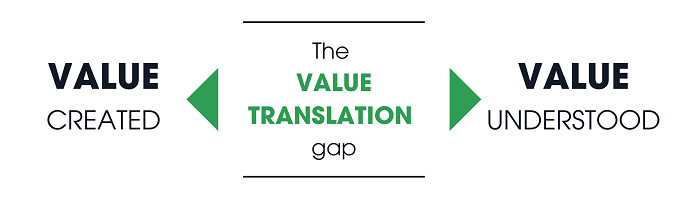
In many organisations there is a significant gap between the value a company actually creates and the value the market understands - and is therefore willing to pay for. I refer to this as the Value Translation Gap: the distance between the value a company creates for its customers and the value the market recognises, remembers, and rewards.
In industries like logistics, that gap can be surprisingly large. Operational teams solve complex problems every day. They stabilise supply chains, manage volatility, protect delivery promises, and ensure that customers receive the products they depend on. Yet when those same capabilities are described to the market, they are often reduced to lists of services or technical features: transport, warehousing, routing optimisation, planning algorithms.
I experienced this first-hand while evaluating routing and scheduling software in a logistics operation I was responsible for. We spoke to four different providers, and each one introduced their solution in almost exactly the same way. They talked about their algorithms, their years of experience, and their optimisation capabilities.
Different companies. Different technology. But essentially the same story: what their software does, with very little articulation of the reality we were dealing with or how their solution would improve it.
So we did what many buyers do when every vendor sounds similar… we compared them on price.
The irony is that the real problem we were trying to solve had very little to do with route optimisation. At the time, the relationship between sales and logistics had become increasingly strained. Orders arrived throughout the day, often long after the operational planning process had begun, with little discipline around order cut-off times, delivery territories, or smoothing volumes across delivery days. As pressure mounted, finger-pointing between departments became far more common than the collaboration that was urgently needed.
From the sales perspective, the expectation was simple: logistics should make a plan. From the logistics perspective, the reality was very different.
Late orders forced planning cycles to restart, pushing back picking and loading activities and delaying morning start-ups. With no volume smoothing, no dedicated delivery days, and an open invitation to customers - effectively a “you call, we haul” approach - demand fluctuated wildly. Some days trucks stood idle in the yard; on other days we hired additional vehicles and paid significant overtime just to keep up. Delivery promises became harder to keep, and the gap between communicated ETAs and actual arrival times steadily widened.
The logistics team knew the system was becoming unstable. The problem was that we struggled to explain why. Without clear visibility of capacity, territories, and routing constraints, the conversation between sales and logistics often became a debate of opinions. Sales believed logistics simply needed to be more flexible. Logistics knew the system required discipline, but we lacked the evidence to demonstrate it.
That changed once sophisticated routing and scheduling tools were introduced.
For the first time, we could clearly demonstrate how the delivery network actually worked. We could show how many vehicles were available, how territories were structured, and how late orders forced the entire planning process to restart. We could also demonstrate how fluctuating volumes across delivery days created inefficiencies throughout the system - with underutilised resources on some days and costly rented resources and overtime on others.
What had previously been a conversation driven by frustration became a conversation driven by evidence. And something unexpected happened.
Logistics regained credibility, and sales and logistics began to operate as true partners, each playing their role in ensuring the organisation could deliver on its customer promise. Sales teams could now see that delivery performance was not simply a matter of trying harder. It depended on a system that required discipline: order cut-off times, delivery territories, minimum order quantities, and smoother volumes across the week.
The routing system had not just optimised routes. It translated operational reality into something the rest of the organisation could understand - and support through their actions and decisions. When logistics said, “Help us to help you,” we could now finish that sentence with clear, data-backed requests.
In other words, the system helped close the Value Translation Gap inside the organisation.
But the lesson extends far beyond logistics operations. It also explains why many solutions struggle to command the attention and value they deserve in the market.
Customers do not buy products or services simply because of their features, technical specifications, or the experience of the company providing them. They buy them because those solutions help them solve a problem or make progress in their world. That progress can take many forms: functional improvement, risk reduction, financial impact, or personal and social outcomes such as enabling better collaboration across teams. Often, it is several of these at once.
Yet many solution providers still describe their offerings in the language of their own organisation – their technology, their experience, their capabilities, their features. All of these elements are important, but they should support the story rather than be the story.
From the customer’s perspective, the real question is much simpler: What problem are you helping me solve? Or put differently: What progress are you helping me make?
The same thinking applies across many logistics services.
A labour provider, for example, may say they supply warehouse staff. But in many FMCG businesses, the festive season represents a disproportionate share of annual profitability. It is not uncommon for December to represent only around eight percent of the year in terms of time, yet contribute as much as twenty-five percent of annual profit.
And yet this is precisely the time when staffing becomes least reliable. Social gatherings increase, employees travel to other provinces to celebrate with family, and some fail to return to work on time. Operations suddenly struggle to maintain consistent staffing levels at the very moment when volumes - and customer expectations - are at their highest.
In that situation, the real job of a labour provider is not simply to supply warehouse staff. It is to ensure that reliable people show up when the business counts on them the most - at precisely the time when it is hardest to guarantee consistent resources.
When solution providers understand the real progress their customers are trying to make, their messaging changes. They stop describing what they do and start explaining why it matters.
Because operational excellence only creates commercial value when the market understands it.
Closing that gap - the Value Translation Gap - is often the difference between competing on price and being recognised, remembered, and chosen for the value you truly create.

Yolandi Mitchell, Mondegreen
Linkedin: https://www.linkedin.com/in/yolandi-mitchell-60a284334/