SA’s first fully operational intermodal freight village in the small KwaZulu-Natal town of Estcourt is not only actively addressing the inefficiencies and congestion along South Africa’s busiest road freight corridor between Durban and Gauteng but is about to expand into a multi-billion-rand operation that will set an important precedent for containing logistics costs and making local manufacturers more competitive, says EIT Group CEO Wessel Jacobs.
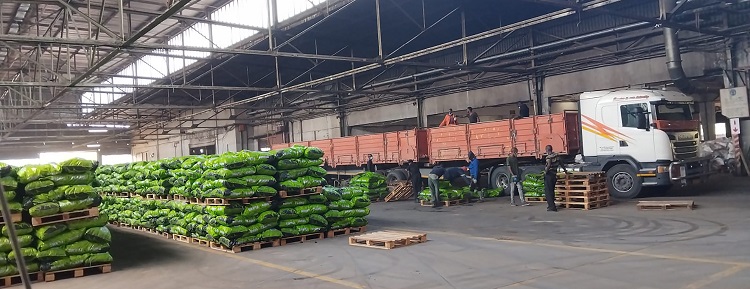
EIT Group’s Estcourt Intermodal Freight Village, which is modelled on similar facilities in Eastern Europe, comprises a multi-mode logistics centre that provides a broad range of transport, logistics services and value-add supply chain services for both national and international cargo. It currently caters for containerised cargo, with the ability to include bulk commodities on the horizon.
The expanded intermodal freight village is expected to not only create jobs and grow the small town of Estcourt – a strategy at the heart of government’s economic recovery plan – but cut transport costs to South Africa’s main port by as much as 50%, making local manufacturers far more competitive both regionally and internationally says EIT Group Chief Financial Officer, Manka Sebastian.
“When you look at Europe, transport costs make up 10% of imports and 8% of exports. In Asia, logistics accounts for 19% of imports and 16% of exports. In Africa, 45% of our import costs come from transport and 35% of our export costs do too. If we now play our part and make logistics between 30 and 50% more cost efficient, we could nullify the punitive tariffs imposed by the Trump administration,” she suggests.
The Estcourt intermodal freight village is located on the former site of the Masonite board manufacturing facility. According to Jacobs and Sebastian, it is critical to locate facilities such as this at the most economically efficient point along the route – in this case, along the N3 and rail corridor junction, 567km by rail from the Transnet City Deep container terminal and Sentrarand switching yards in Gauteng and 176km from the Container Terminal and Bayhead main rail terminal at the Durban port.
The EIT Freight Village represents a long overdue marriage between road and rail that addresses two of SA’s largest logistics conundrums – an inefficient and run down rail network (expected to take more than 10 years and around R80-billion to turn around) and an ever-growing army of trucks that are not only a safety hazard but damaging road infrastructure.
Right now, approximately 7 000 trucks operate along the N3 daily, moving about 27.5 million tons of road freight annually. Road transport accounts for over 85% of all freight moved with rail accounting for less than 14%.
Goods trucked from Gauteng to the small KwaZulu-Natal town can be transferred to rail at Estcourt to complete the journey to the busy port of Durban. The opposite takes place for imports.
Jacobs says that avoiding this small stretch of the freight journey, which is characterized by steep inclines and high fuel costs, accidents, delays and days-long congestion at the port and ultimately accounts for 50% of the costs is a game changer and will take trucks off the roads.
In addition, warehousing and other essential infrastructure in Estcourt is available at a fraction of the cost when compared to main city centres.
Jacobs said that the former Masonite site was perfect as it had an existing rail link that has been completely refurbished. The first phase of the development is now complete, and the freight village has been fully operational since March 2024.
“This was the proof-of-concept phase. We are now moving on to further expansion plans. We are going to enlarge terminal one which is 60 000 sq/m. We’ve also taken an option to expand to the other side of the rail line. This will provide a 500-hectare site on which we will build a second terminal. We want to use terminal one for clean cargo and terminal two for minerals and other dirty cargo,” he says.
EIT’s first test train ran in November 2023, and operations officially began in March 2024. Negotiations with Transnet Freight Rail delivered three slots to run trains on the main line to Durban each week with well-advanced plans to increase this to three trains daily in the near future.
Sebastain says that EIT Group has cultivated strong collaborative relationships with both the public and private sectors. Security is on call to address any safety concerns surrounding train stoppage and ongoing work with Transnet Freight Rail addresses any other challenges.
“To date, we are yet to miss a single vessel at the port,” Jacobs concludes.