


Page 23 - Logistics News June 2019
P. 23
Cold Chain Logistics


          a refrigerated fl eet requires
          signifi cant capital investment,
          specially trained drivers, increased
          liability and a greater risk for close
          inspection.
            Cold chain operators are eager
          to fi nd new strategies to reduce
          costs. In retail, requirements for
          smaller, more frequent orders
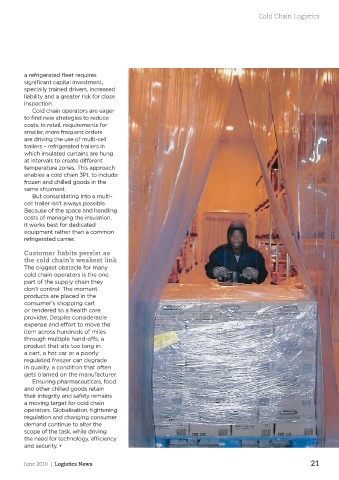
          are driving the use of multi-cell
          trailers – refrigerated trailers in
          which insulated curtains are hung
          at intervals to create diff erent
          temperature zones. This approach
          enables a cold chain 3PL to include
          frozen and chilled goods in the
          same shipment.
            But consolidating into a multi-
          cell trailer isn’t always possible.
          Because of the space and handling
          costs of managing the insulation,
          it works best for dedicated
          equipment rather than a common
          refrigerated carrier.

          Customer habits persist as
          the cold chain’s weakest link
          The biggest obstacle for many
          cold chain operators is the one
          part of the supply chain they
          don’t control: The moment
          products are placed in the
          consumer’s shopping cart
          or tendered to a health care
          provider. Despite considerable
          expense and eff ort to move the
          item across hundreds of miles
          through multiple hand-off s, a
          product that sits too long in
          a cart, a hot car or a poorly
          regulated freezer can degrade
          in quality, a condition that often
          gets blamed on the manufacturer.
            Ensuring pharmaceuticals, food
          and other chilled goods retain
          their integrity and safety remains
          a moving target for cold chain
          operators. Globalisation, tightening
          regulation and changing consumer
          demand continue to alter the
          scope of the task, while driving
          the need for technology, effi  ciency
          and security. •


          June 2019  |  Logistics News                                                                        21

